Just Plane Crazy
Welcome to JustPC
About JustPC
Family Album
Guestbook
Savvy Online Shopping
Top
Overview
Safety tips
Conversation
Savvy Online Shopping


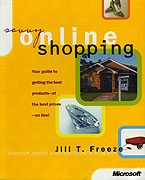
- Written by: Jill T. Freeze
- Published by: Microsoft Press, 2000
- ISBN: 0-7356-2242-6
Overview
Whether it is a new dryer, a Barbie doll or a car, the Internet can make it easy for shoppers to find products faster this holiday season - wihtout the long lines, crowds and parking skirmishes. But how can consumers shop safely, and find the best bargins online? Savvy Online Shopping by Jill T. Freeze has answers to these questions, along with many practical tips that will demystify the world of online shopping.
Written in a fun and easy-to-read style, Savvy Online Shopping is not just another directory of retailers on the web, by a guerilla-shopping guide devoted to educating consumers about the wide range of benefits that come with shopping online. Author and hardcore e-shopper Jill T. Freeze becomes the reader's personal e-shopping consultant, and shares inside tips and tricks for shopping securely, protecting pricacy and bargin hunting online. Readers can go e-shopping with Jill - without having to pay the costs of hiring a personal shopping consultant - and will learn how to find nearly anything online, how to conduct product research, and how to try items before making a purchase.
With Savvy Online Shopping readers will:
- Discover what kind of merchandise is available to try before making a purchase
- Learn how to determine a fair price for an item by using online price guides
- Check a seller's credibility
- Keep private information safe on the web
- Know what to ask a seller before bidding at online auctions
- Find out where to find freebies, coupons and rebates on the 'net.
The Savvy Shopper's Top Ten Online Shopping Safety Tips
- Only place orders through sites with an https:// prefix on the page that requests your payment information. These sites support SSL, a security protocol to protect your payment information and privacy.
- Pay with a credit as often as possible. That way you can take advantage of the card's insurance should something go wrong with the purchase.
- Never provide your social security number online! There is no reason whatsoever that you hsould have to provide such a private piece of information over the Internet.
- Insist on privacy. Look for a printed pricacy policy on the merchant's website.
- Research individuals and merchants thoroughly before buying anything from them.
- Shop at sites with safe shopping gaurantees or customer insurance to minimize the chances of a deal going bad.
- Know what you're buying before you place an order. Make sure all the questions are addressed before money is exchanged, research the product online, consult the manufacturer's websites for specs, locate owner/user reviews, and check out online value and condition grading guides for collectibles.
- Before responding to what might appear to be a lucrative e-mail offer, visit www.consumer.gov to familiarize yourself with the most common Internet scams.
- Know shipping costs, handling fees, and payment terms before agreeing to anything. This is especially true of online auctions where shipping fees are often set at the discretion of an individual.
- Get familiar with the recourse you can take if something goes wrong.
A conversation with Jill T. Freeze, Internet zealot and hardcore e-shopper
What will the new trends be for online shopping this season?
Since last year, the acceptance of credit cards has become almost universal on the web. Thanks to special services like PayPal.com, individuals can now accept credit cards for purchases just like the big e-tailers can. For online shoppers, that often means a huge increase in the number of potential shopping outlets, speedier transactions, and additional purchasing protection.
Just as important, consumers this year are now willing to shop online during the non-holiday season. THis year's back-to-school season gave many e-tailers a shot in the arm, and many people are turning to the Internet on a regular basis to print out online grocery coupons, check sales at local stores, and so on.
Will shopping online be safer or easier this year?
Both! Have you ever noticed how every product out there eventually carries a "new and improved" lavel at one time or another? Well, online shopping is no exception.
As dot coms learn what consumers want, like, and even fear about their online shopping experience, they create nifty tools like virtual shopping carts, to make online shopping as familiar and no-threatening as offline shopping, or sophisticated comparision shopping "bots" which provide the best price on a given product. As far as safety goes, more and more e-tailers are offering safe shopping guarantees, or are taking bigger steps to educate consumers about how they plan to keep their visitors safe.
What are the most important rules to shopping safely and avoiding fraud?
Rule number one is YOU MUST ASK QUESTIONS! Leave no stone unturned, and this goes for boying from an established e-tailer, an individual listing an item in an online auction, or a small upstart web site that only accepts checks or money orders.
Many experienced e-tailers or auctioning individuals know what information puts a prospective buyer at ease, and the do their best to disclose it on the web page. Unfortuantately, unasked questions about shipping costs, delivery time, and the condition of a used item can leave inexperienced online shoppers feeling like they've been victims of fraud.
And remember, a seller may not be technically committing fraud for what is not said. When I was new to online auctions, I purchased a piece of quilt fabric. I thought I had asked every question necessary before committing to the purchase. Wrong! When I opened the package, the storng smell of cigarette smoke wafted out. The seller didn't specify smoking or non-smoking environment in her ad, and I didn't ask. My own fault entirely. No matter how trivial it may seem, if it's important to you, ASK!
How can I be sure that I'm shopping safely?
While many web sites tell you whether or not you're on a secure site, the most trusted method is to consult your web browser. Microsoft Internet Explorer, for example, puts a padlock icon at the bottom of the screen to let you know you're working with a safe server. Also, before entering payment information, look at the web site's address. If the usual http: prefix reads https: or shttp:, you're safe!
However, there's one major caveat to this: web sites generally only use secure servers for the ordering process, which means a site may look totally insecure until you actually attempt to place an order. It's vitally important that you be viewing an order page before performing these security checks, otherwise even the safest of sites will scare you off.
What can I do to stay ahead in online auctions like eBay?
There's nothing like an auction to get the adrenalin pumpin'! You see something that appears to be going for a bargin basement price, so you place your bid. In the final minutes, others sneak in and place their bids. At that point, what was once a bargain-hunting challenge becomes a fierce competition for who can walk away with the "prize" (which, at that point, has become anything but a bargain!)
In order to preserve your sanity, I suggest researching the value of an item before the bidding frenzy begins. WorthGuide at www.WorthGuide.com helps you place a value on many commonly auctioned items. Use that value as a starting guide for what you're willing to pay for an item, then adjust it up or down based on how important getting the item immediately is to you. And once you set that value, STICK TO IT!
Timing your shopping trip can also be helpful. On high-travel days or holidays, there are fewer people online to compete for that treasure, thus lowering the price. The flipside? Many sellers have figured that out too, and no longer end auctions during those times! There are still many good deals to be had, though.
Is it better to find a speciality retailer or a one-stop shopping site like Amazon?
That's really a matter of personal preference. What you may not know is that one-stop e-tailers may not warehouse all of their inventory in one location. For example, books may ship out of Texas, and toys out of California. If the object is to get one package, that may not happen no matter where you shop.
On the other hand, if you want to complete all of your holiday shopping online, a one stop e-tailer can really save some time since you have to enter payment and shipping information one time. The downside is you may not have a full range of products/brands from which to choose. See? There's no clear-cust "best" answer to this one!
How can I comparision shop on the web to find the best price and the best itmes for my needs?
A whole crop of comparision shopping tools have popped up including mySimon (www.mySimon.com), DealTime (www.DealTime.com) and eCompare (www.eCompare.com).
Finding the best item is a bit trickier. First off, many manufacturer's web sites let you compare one model with another. But the most fun and object tool is called a decision guide. Such a guide gives you a customized list of products (usually ranked from best to worst) based on your answers to a series of questions and how you rank the importance of various features. Decision guides not only exist for things like digital cameras and refrigerators, but you'll also find them for other lifestyle decisions as well. For example, you can find help in choosing the breed of dog for you, the most appropriate college, the best place to live, even the best presidential candiate given your personal preferences and values! Visit PersonaLogic at www.PersonaLogic.com to check out some of these decision guides. Others can be found at various locations around the 'net.
Are there other ways of paying for online purchases rather than submitting my credit card number?
PayPay (www.PayPal.com) lets you put funds (including electronic checks) into an account, which can be used to pay for purchases a lot like a credit card, but without the risk. Many e-tailers will even accept electronic checks online or over the phone if you prefer.